
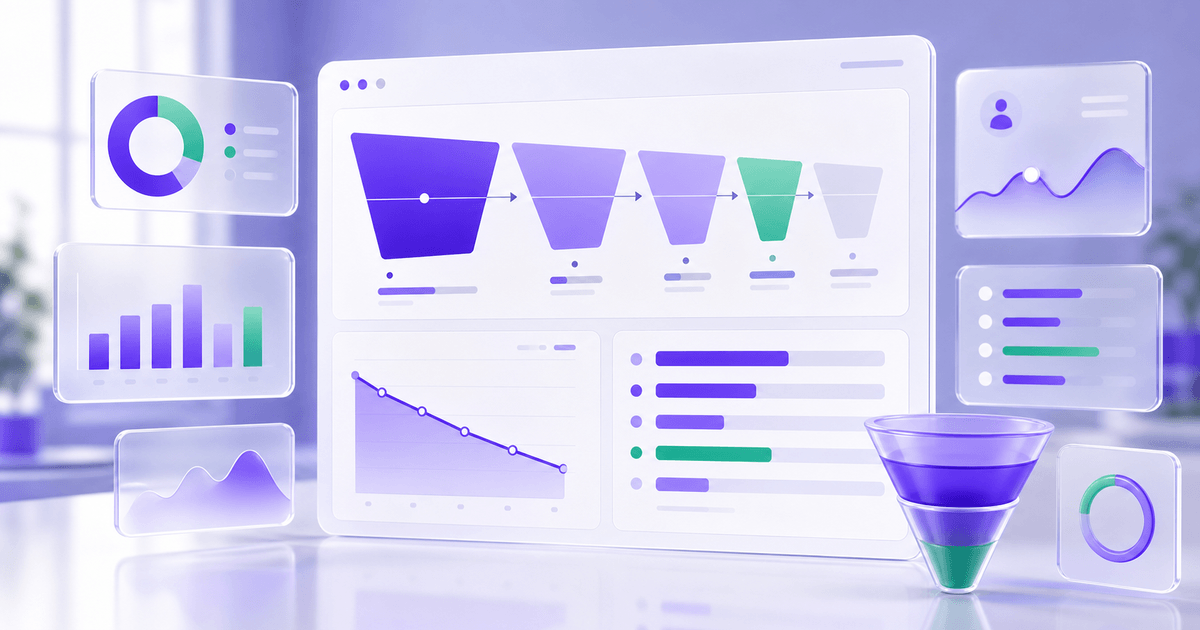
Publishing a quiz is only the beginning. The real advantage appears when you understand how people move through each screen, which answers they choose, and where they decide to leave.
Without metrics, the quiz becomes a black box. You may know how many people arrived, but not why few completed it, why one profile dominates, or why the final button gets fewer clicks than expected.
Start rate
Start rate shows how many people who reached the first screen actually began the quiz. If many visitors arrive but do not start, the issue is usually the opening promise.
Review:
- Does the headline promise a clear result?
- Does the subheadline explain the benefit quickly?
- Is the start button direct?
- Does the first screen load fast on mobile?
A strong opening reduces doubt. The visitor should understand what they will get and how much effort it takes.
Completion rate
Completion rate measures how many people reach the end. It is one of the most important metrics because it shows whether the quiz is too long, confusing, or misaligned with the promise.
If completion is low, review the length of the flow. Often, removing a secondary question improves results more than rewriting all copy.
Also check whether a sensitive question appears too early. Asking for revenue, phone number, or personal details before building trust often creates drop-off.
Drop-off by screen
Drop-off by screen shows where visitors stop. This turns guesses into diagnosis.
If many people leave on the first question, the question may be too difficult or disconnected from the promised outcome. If drop-off happens on the lead capture screen, you may be asking for too much data or not explaining the value of the result.
Change one element at a time:
- Simplify the question copy
- Reduce the number of answer options
- Change screen order
- Remove unnecessary fields
- Reinforce the value before lead capture
This makes it easier to see which change actually improved the funnel.
Answer distribution
Answers reveal audience profile. If 70% of leads choose the same pain point, you have a strong signal for offer, content, ads, and sales follow-up.
Use this data to answer:
- Which problem appears most often?
- Which maturity level dominates the audience?
- Which channel or goal brings better leads?
- Is there an answer that signals high buying intent?
The quiz does more than capture contacts. It reveals demand.
Final CTA clicks
The final button click shows whether the result convinced the visitor to continue. A result screen can have high views and low clicks if the CTA is generic.
Replace "Learn more" with a specific action:
- "Book a diagnosis"
- "See the recommended plan"
- "Get a proposal"
- "Access the recommended lesson"
- "Talk to a specialist"
The more connected the CTA is to the result, the stronger the click intent tends to be.
Connect metrics to paid traffic
If the quiz supports paid campaigns, connect events to your media workflow. Views, starts, completions, lead captures, and final clicks help you compare audiences and creatives by interaction quality, not just cheap clicks.
With Quizzerfy, funnel and answer tracking helps you understand what happens after the ad click. That reduces reliance on shallow metrics such as reach or likes.
The key idea
The best quiz is not perfect on day one. It improves with each round of data.
Track starts, completion, drop-off, answers, and final clicks. Those five signals show where friction exists, which segments matter, and which next action needs to be clearer.
To start measuring this flow in a real quiz, create your Quizzerfy account.